
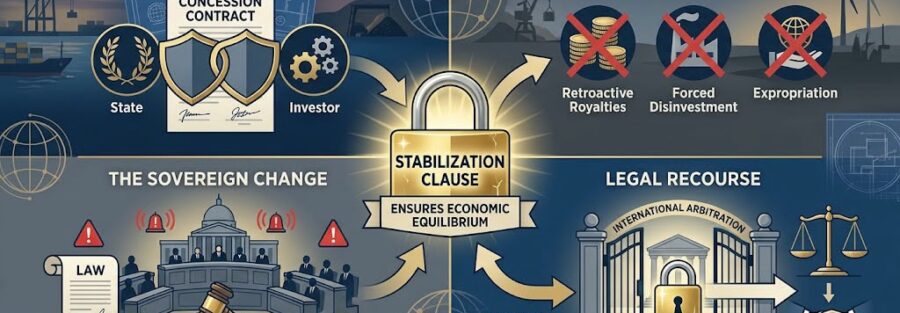
Concession agreements in capital intensive sectors such as mining, energy, and large-scale infrastructure are built on long pay-back horizons. Over a 20 to 50-year project lifecycle, host governments undergo political transitions, economic shifts, and policy realignments. This exposes private sponsors and foreign investors to acute concession risk: the threat that subsequent legislative or administrative changes will undermine the project’s financial model.
To counter this, stabilization clauses serve as the primary legal mechanism to insulate projects from post-signing sovereign interference.
Key Forms of Stabilization Clauses
Stabilization provisions are not uniform; they are negotiated across a spectrum of legal enforceability and financial protection:
A. Freezing Clauses (Classic Stabilization): This mechanism “Freezes” the host nation’s domestic legal and regulatory framework as it existed on the date of contract execution.
Effect: Any subsequent legislative changes, new taxes, or increased environmental burdens enacted by the state simply do not apply to the concessionaire.
B. Economic Balancing Clauses (Equilibrium Provisions: This mechanism acknowledges the state’s sovereign right to pass new laws, but requires the host government to financially compensate the concessionaire or modify contract terms if new regulations increase operational costs or diminish returns.
Effect: Restores the original financial equilibrium through tax adjustments, tariff increases, or direct cash offsets.
C. Hybrid Clauses: This mechanism combines elements of both. They typically freeze specific core terms (such as royalties, corporate tax rates, or profit repatriation rights) while requiring negotiation or economic adjustment for broader environmental, labour, or health and safety mandates.
Strategic Utility in Managing Concession Risk
- Mitigating “Creeping Expropriation”: Rather than an outright seizure of assets, host states often erode project value incrementally through surprise levies, local content surcharges, or reduced concession areas. A well-drafted equilibrium clause renders such measures financially neutral to the operation.
- Bankability & Capital Mobilization: Lenders and international finance institutions (IFIs) routinely mandate stabilization provisions as a prerequisite for debt financing, as they directly protect debt service coverage ratios (DSCR) against regulatory shocks.
- Enforceability via International Arbitration: When anchored alongside Bilateral Investment Treaties (BITs), stabilization clauses give concessionaires clear contractual grounds to initiate claims before neutral tribunals (e.g., ICSID or UNCITRAL) should a host state unilaterally alter terms.
Evolving Challenges & Balancing Public Interest
Modern international law has introduced new complexities to stabilization drafting:
- ESG & Constitutional Overrides: Host states increasingly argue that classic freezing clauses cannot impede their fundamental duty to legislate for environmental protection, climate goals, or human rights.
- Negotiating Modern “Scope Limits”: Modern concessions increasingly favour tailored economic balancing clauses over blanket freezing provisions. This allows host states regulatory flexibility in legitimate public policy areas while protecting the investor’s core economic margins against discriminatory or target driven fiscal changes.
Partner With Us
Drafting and negotiating effective stabilization mechanisms requires a balance between sovereign policy requirements and long-term investor security. Whether you are structuring a new concession, renegotiating fiscal terms with a host government, or reviewing existing agreements for regulatory exposure, our team is equipped to advise. Reach out to discuss how we can secure your cross-border assets.